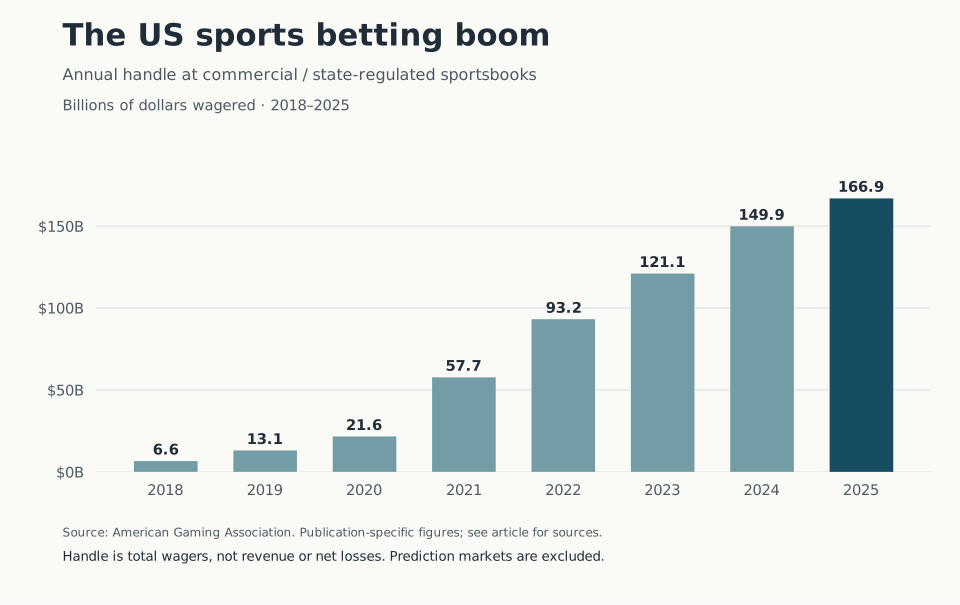
Source: American Gaming Association annual reports and revenue tracker; data and methodology. Handle is the total amount wagered, including money that gets bet again after a win. It is not operator revenue or bettors’ net losses. The AGA sportsbook series does not include Kalshi or Polymarket.
It feels like gambling companies are suddenly everywhere. DraftKings and FanDuel are part of watching sports. Kalshi and Polymarket let you put money behind opinions about elections, economic releases, and games. What used to feel like a fairly separate activity now shows up in the same places where you follow the news or check your investments.
The graph gives some sense of how much has changed. Annual wagers through the sportsbooks tracked by the AGA grew roughly 25 times between 2018 and 2025. And that’s before adding prediction markets, which operate through a different structure and aren’t included in those numbers.
My read is that we’re watching two overlapping expansions. First, states opened up sports betting. Then prediction markets started testing how much of the same activity could happen through financial exchanges. In both cases, software made it much easier to turn permission to operate into a product that millions of people could use.
First, the law changed
The biggest reason for the timing is surprisingly straightforward. In May 2018, the Supreme Court struck down the Professional and Amateur Sports Protection Act in Murphy v. NCAA. That federal law had largely prevented states from authorizing sports betting. The decision let states make their own choices; it didn’t itself legalize sports betting everywhere.
That created a succession of new markets. Each state that allowed online wagering gave companies another group of customers to compete for. The AGA credits new markets and mobile launches in places including New York, Louisiana, and Maryland with helping drive 2022’s expansion. Five more states launched legal sports betting in 2023.
This is important when reading the graph. Some growth is people betting more. Some is people betting legally instead of through an offshore site or a bookie. Some is the measured market expanding as more states participate. The chart alone can’t tell us how much comes from each.
For a company, though, all three can create an opportunity. You don’t need to invent people’s interest in betting on football. You need to become the app they open once it’s available where they live.
Phones changed the size of the opportunity
Imagine two versions of the same business. In one, a customer travels to a casino to place a bet. In the other, they open an app during a commercial break.
The second version can become a much more frequent habit. It also gives the company more opportunities to offer another bet: before a game, during it, or on an individual player’s performance. The scarce resource becomes the customer’s attention.
That helps explain why the advertising is so visible. DraftKings reported roughly 1.26 billion dollars in sales and marketing expense in 2024, across its business. That’s a substantial amount of money spent making sure people recognize and return to an app.
Sports organizations became distribution partners, too. The NBA named DraftKings and FanDuel co-official sports betting partners in 2021, with rights to league and team branding and integrations across NBA platforms. Betting could now appear inside the experience of being a fan.
The business logic is easy to understand. If a customer keeps coming back, acquiring that customer can be worth a lot. But the enormous wagering total isn’t the amount companies get to keep. In 2025, the AGA reported 166.94 billion dollars in handle and 16.96 billion dollars in sportsbook revenue—about 10% of the amount wagered, before operating expenses and taxes. It also reported 3.71 billion dollars in state sportsbook taxes. Customers, operators, sports partners, and state governments all became participants in a much larger business.
Prediction markets opened another route
Kalshi and Polymarket look similar to sportsbooks from a user’s perspective: put money behind an outcome, and get paid if you’re right. But the structure matters.
A conventional sportsbook posts odds and takes bets. An exchange matches buyers and sellers of contracts. A simple event contract might pay one dollar if a specified event happens and zero if it doesn’t. Buy it for 60 cents and hold it to settlement, and you either make 40 cents or lose 60 cents, before fees. The price can be read as a rough market-implied probability, although fees, liquidity, and who is trading can distort it.
Kalshi received CFTC designation as a contract market in 2020. The CFTC is the federal regulator for derivatives markets. Polymarket took a different path: in July 2025 it announced the 112-million-dollar acquisition of QCEX, a US-regulated exchange and clearinghouse, to support its return to the US. Its international platform and US business shouldn’t be treated as interchangeable when discussing regulation or trading volumes.
The commercial attraction is obvious. If event contracts can operate under federal derivatives rules, companies have a potential route to customers beyond the state-by-state sportsbook system. That possibility is a powerful incentive to enter the market.
But the boundary remains contested. In April 2026, the CFTC sued Arizona, Connecticut, and Illinois, asserting its exclusive jurisdiction over prediction markets. States have argued that sports contracts are gambling subject to their laws. Courts have not produced a uniform answer: in August, an appeals panel declined to let Kalshi resume sports and election trading in Nevada while litigation continued.
So this isn’t simply a story about an unregulated industry. It’s a fight over which regulatory framework applies, and what products that framework permits. That fight is still underway as of September 2026.
More brands can mean more ways into the same market
There’s another reason it feels like the number of betting companies has exploded: an existing financial app can add prediction markets without building an exchange itself.
Robinhood launched its prediction markets hub in March 2025, initially offering contracts through Kalshi. The launch included both economic and basketball outcomes. In May 2026, Interactive Brokers announced one interface connecting Kalshi, CME Group, and ForecastEx.
That means counting apps can overstate the number of independent markets underneath them. Several familiar brands can distribute access to the same exchange. For the exchange, distribution brings traders. For the distributor, it adds something else an existing customer can do with an existing account.
Prediction markets also have a useful distribution mechanism of their own: the price is content. A probability about an election can be shared in an article or group chat. Someone who would never browse a sportsbook can encounter a market while reading the news.
Forecasting and gambling can coexist
I think the appeal of prediction markets is real. People have opinions about uncertain events, and putting money behind a claim can make it more informative than a confident social media post. A well-designed market can aggregate information or let someone offset a risk they already face.
But those uses don’t tell us what drives the commercial business. Sports provide frequent events, clear results, and an existing audience. The AGA estimated in September 2026 that sports represented about 80% of Kalshi’s volume. That’s an industry association’s estimate, from an organization representing competitors and advocating against these products. Still, it illustrates why the two industries are colliding.
The same interface can serve someone hedging an economic risk and someone looking for another wager. Calling it a prediction market doesn’t resolve the question of which behavior its business model rewards.
That, to me, is why there are suddenly so many gambling companies. A large existing appetite met newly available legal routes, inexpensive digital distribution, and businesses with a strong incentive to turn occasional participation into a recurring habit. Prediction markets then expanded both the range of things people could bet on and the set of companies that could distribute those bets.
The interesting question now is how much of the next wave will produce useful information—and how much will make placing another bet an ordinary part of opening any app.
Chart sources
The opening chart shows annual nominal US dollars wagered through commercial and state-regulated sportsbooks covered by the AGA. It is not a count of companies, an estimate of all US gambling, or a prediction-market volume series. It does not comprehensively cover tribal sportsbook activity. Calendar year 2026 is omitted because it is incomplete.
| Year | Handle, billions of dollars | AGA source |
|---|---|---|
| 2018 | 6.58 | State of the States 2021 |
| 2019 | 13.07 | State of the States 2021 |
| 2020 | 21.60 | State of the States 2022, p. 11 |
| 2021 | 57.71 | State of the States 2022, p. 11 |
| 2022 | 93.20 | State of the States 2023 |
| 2023 | 121.06 | State of the States 2024 |
| 2024 | 149.90 | State of the States 2025 |
| 2025 | 166.94 | 2025 Commercial Gaming Revenue release |
These are the figures in the cited publications; the AGA revises historical data as state reports change, so they can differ from earlier releases or later comparisons. The cited AGA reports do not provide a comparable annual US-only Kalshi-and-Polymarket series. Adding global exchange volume to US sportsbook handle would imply a precision and comparability the data don’t support.